What Are Calories
Calories are often talked about as if they are mysterious or interchangeable, but at a basic level they are simply a unit of energy. In this article, we break down what calories actually are, how they are measured, and how your body uses them to fuel everyday functions like movement, digestion, and temperature regulation. We also look at how calories relate to food, why not all calories behave exactly the same in the body, and how factors like body size, muscle mass, hormones, and activity level influence your calorie needs.
 makko
makko 
Calories: the definition people actually need
When I say “calories,” I’m not talking about morality, willpower, or whether a food is “clean.” I’m talking about energy. Energy is the currency your body uses to keep you alive, move you around, and rebuild tissue. If you’ve ever wondered why two weeks of “eating healthy” didn’t move the scale, or why a “small snack” can stall progress, you’re already asking a calories question, whether you use the word or not.
Scientifically, a calorie is a unit of energy that originally described heat. In modern nutrition, “Calories” on labels are kilocalories (kcal), not the smaller “calorie” (cal). One kilocalorie equals 1,000 small calories. The conversion to the metric energy unit is straightforward: 1 calorie is 4.184 joules, so 1 kilocalorie is 4184 kilojoules.
On U.S. food labels, calories are defined as the energy you get from the macronutrients in a serving, and the explicitly spells this out: calories come from carbohydrate, fat, protein, and alcohol.
The word has a surprisingly messy history. The “Calorie” (kcal) as a nutrition term traces back to early 19th-century work on heat engines. It later got popularized in food and diet contexts through late-1800s writing on food energy, including work associated with early nutrition research and food-energy tables. That’s why we still have the capital-C “Calorie” convention hanging around, even though the joule is the SI standard.
A quick misconception cleanup that will save you time:
- A calorie is not “bad.” It’s just energy.
- “Healthy foods” still contain calories. Some are easy to overeat because they’re energy-dense or highly palatable.
- Calories are not perfectly measurable in everyday life. Treat them like a useful estimate, not a courtroom verdict.
Where your daily “calories out” comes from
A calorie on a label is “energy in.” What your body does with that energy is where people get tripped up. Total daily energy expenditure (sometimes called TEE or TDEE) is usually described as a few major buckets:
- Resting energy expenditure (REE), closely related to resting metabolic rate (RMR)
- The thermic effect of food (TEF), also called diet-induced thermogenesis
- Physical activity energy expenditure, which includes both structured exercise and non-exercise activity thermogenesis (NEAT)
For an “average” adult, resting energy expenditure is typically the biggest chunk, often around 60–70% of total daily energy expenditure. TEF is commonly around ~10% of daily energy expenditure. Physical activity is the wildcard: it can be as low as ~15% in sedentary people and can rise dramatically in very active people.
NEAT deserves special attention because it’s both powerful and underrated. NEAT is the energy you spend doing everything that’s not sleeping, eating, or intentional exercise: walking around, working, fidgeting, chores, posture, all of it.
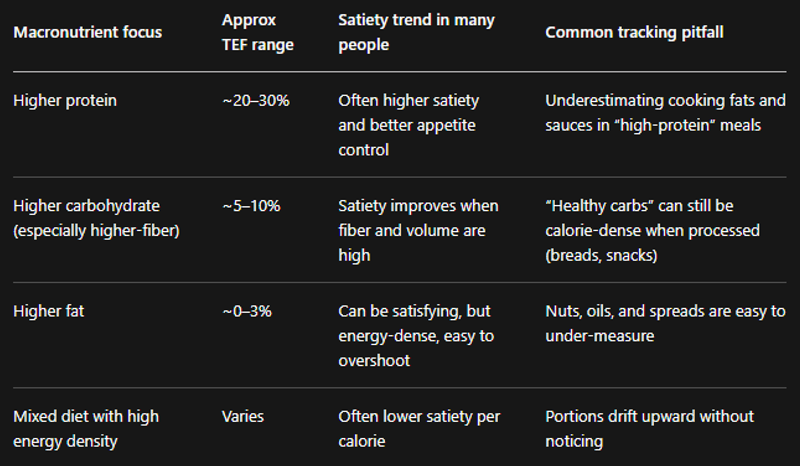
TEF is also not uniform. Digestion and processing costs depend on what you eat. Protein generally has the highest thermic effect, carbohydrates are intermediate, and fat is lowest. A widely cited set of approximate ranges: about 0–3% for fat, 5–10% for carbohydrate, and 20–30% for protein, with alcohol also having a notable thermic effect.
Two practical implications follow from that:
First, “my metabolism is slow” is sometimes true, but it’s rarely the whole story. Resting energy expenditure varies with age, sex, body size, and body composition, and it can shift during weight loss due to adaptive responses.
Second, if you’re trying to change your body weight, you’re almost always changing multiple buckets at once. People often focus on exercise, but in day-to-day life, food intake and NEAT changes can dwarf a few gym sessions. Models of long-term weight change specifically note that both energy intake and expenditure adapt over time, and those adaptations matter for realistic expectations.
How calories are measured and why labels are estimates
If calories are energy, the obvious question is: how do we measure them?
The “pure” lab method starts with combustion. You can dry a food, burn it in a bomb calorimeter, and measure gross energy released as heat. But gross energy is not what your body actually gets. Humans do not digest and absorb 100% of what we eat, and we lose energy in feces and urine. That’s why nutrition uses metabolizable energy, not gross energy.
In the U.S., calorie labeling is governed by regulation that permits multiple legal methods for calculating calories. Those methods include using Atwater factors (general or food-specific), using FDA-approved specific factors for certain ingredients, and using bomb calorimetry methods with corrections.
The famous Atwater general factors are the ones most people know:
- 4 kcal per gram for protein
- 4 kcal per gram for carbohydrate
- 9 kcal per gram for fat
But even inside U.S. regulations, there’s nuance: some non-digestible carbohydrates have a different assigned energy value, and sugar alcohols have their own factors. That’s the law implicitly admitting the main point: “carb is 4 kcal/g” is a simplification.
So how inaccurate are label calories, really?
One limitation is conceptual: metabolizable energy varies with fiber content, food structure, processing, and individual digestion. A review on “dietary energy” points out that even within the FDA-approved calculation methods, the same food can come out with meaningfully different calorie totals depending on which legal method is used.
Another limitation is practical: real-world labels can drift. Under U.S. compliance rules, a food is considered misbranded if the analyzed calories exceed the label by more than 20%. That means there is a legally tolerated gap where actual calories can be higher than declared.
A third limitation is that Atwater factors sometimes miss badly for certain foods and dietary patterns. Examples from controlled feeding work:
- In a controlled human study, the measured metabolizable energy of almonds was about 32% lower than the value predicted by Atwater factors.
- In a study testing low-fat, high-fiber diets, metabolizable energy calculated by Atwater methods differed from measured values by up to ~11% in the high-fiber conditions.
- Newer work continues to find overestimation for some legumes (example: chickpeas and lentils showing measured metabolizable energy below Atwater estimates).
None of that means you should ignore calories. It means you should treat calories the same way you treat speed limits in a snowstorm: still the right framework, just not the whole situational picture.
Calories and weight change: what works, what breaks, what adapts
Weight change happens when “energy in” and “energy out” are out of balance over time. That statement is true, but it’s incomplete in the exact way that frustrates people: both sides of the equation move. Your energy expenditure changes as your weight and body composition change, and behavior often shifts too (hunger, cravings, spontaneous movement).
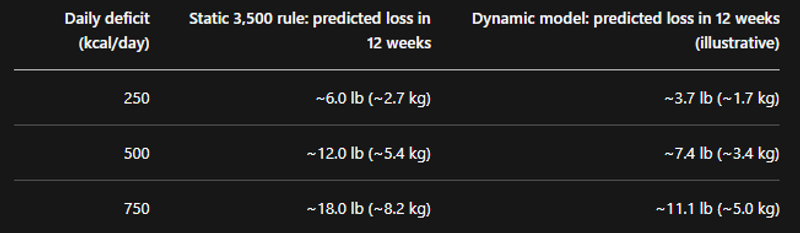
This is where the classic “3,500 kcal per pound” rule collapses. The rule basically assumes a linear relationship: cut 500 kcal/day, lose about a pound per week, forever. Researchers have been direct about why that fails: it ignores dynamic adaptations in energy expenditure and the changing cost of moving a smaller body.
A key modern alternative comes from dynamic models of weight change. and colleagues published a validated model and, importantly, offered a practical rule of thumb to replace the 3,500-kcal myth: for an average overweight adult, a persistent change of about 10 kcal/day leads to an eventual bodyweight change of about 1 pound (or 100 kJ/day for ~1 kg), with about half of the total change achieved in ~1 year and ~95% achieved in ~3 years.
That has two implications I want readers to internalize:
- Early progress is not the same as long-term progress. The scale can move quickly in the first 1–2 weeks because glycogen and water shift, especially when carbohydrate intake drops. That can make “fat loss speed” feel faster than it is.
- Plateaus are not moral failures. They’re often math plus physiology: your body needs fewer calories at a lower weight, and resting energy expenditure can drop more than predicted in some people (adaptive thermogenesis or energy compensation).
Chart and table to include here (core pillar visual): 12-week weight-loss predictions, static vs dynamic
Below is an illustrative comparison for three daily deficit sizes over 12 weeks. The “static” estimate uses the 3,500-kcal rule. The “dynamic” estimate uses ’s rule-of-thumb for eventual weight change plus the stated time course (half the change in ~1 year). This is not a personalized prediction, and real results vary with adherence, water shifts, and physiology.
Why two people can eat the same calories and get different results
If calories were the only variable, identical calorie intake would produce identical outcomes. Real life does not work that way. The biggest drivers of individual variability tend to be:
Body size and composition. Lean mass (muscle and organs) is metabolically active. Two people at the same body weight can have different resting energy expenditures because they have different ratios of fat mass to fat-free mass, and different organ sizes.
Sex and hormones. On average, men tend to have higher absolute resting energy expenditure largely because they tend to have more fat-free mass, but the story gets more subtle once you adjust for lean mass and other factors. Hormonal differences can also influence fuel use and appetite regulation.
Age and life stage. Energy expenditure tends to shift across the life course, and pregnancy and lactation change energy needs in ways that should be handled with clinician context, not generic calorie targets.
Adaptive thermogenesis and energy compensation. During weight loss, resting energy expenditure can drop more than predicted. A major evidence review in the latest energy DRI work notes that reductions in REE after weight loss can vary widely and can be substantially larger than predicted in some people.
Gut microbiome and digestion. This is not magic, and it’s not a free pass to ignore calories. It’s a real, but still emerging, contributor to how much energy you extract from food and how fermentation products (like short-chain fatty acids) interact with metabolism. Classic microbiome work demonstrated that microbes associated with obesity in mice had greater capacity for energy harvest, and later reviews also emphasize that the microbiome can narrow the gap between gross energy and metabolizable energy, especially through fermentation of otherwise indigestible components.
Medications and clinical conditions. Some medications are associated with weight change through multiple mechanisms, including appetite and energy expenditure changes. This is a “talk to your clinician” zone, but it belongs in any honest calories explainer.
One more human factor that matters: measurement. Even in controlled research, measuring individual energy expenditure precisely is challenging. In the context of weight-loss prediction, the baseline energy requirement for a free-living person cannot typically be measured with precision better than about 5% without specialized methods like doubly labeled water, and larger real-world uncertainty is common.
Practical takeaway: if you are doing “everything right” and results are weird, don’t jump straight to conspiracy theories. Start with the boring levers: logging accuracy, portion creep, activity drift, sleep, and time scale. Then, if needed, talk to a clinician about hormones, meds, or a medical workup.
Calories across diets and real-world tracking
Calories behave the same way across dietary patterns. Whether you eat omnivore, vegetarian, vegan, low-carb, ketogenic, high-carb, gluten-free, or some culturally specific pattern, energy still matters. What changes is how easy or hard a given pattern makes it to control intake, manage hunger, and preserve lean mass.
Here are the levers that actually differ:
Macronutrient composition changes TEF and satiety. Higher protein intake tends to increase thermogenesis and satiety compared with lower-protein patterns, even when calories are controlled.
Food energy density changes how much you can eat for the same calories. Lower-energy-dense foods (often higher in water and fiber, like fruits, vegetables, soups) can help maintain satiety while reducing calorie intake.
Food processing changes ad libitum intake for many people. In an inpatient randomized crossover trial, participants ate more calories and gained weight on an ultra-processed diet compared with an unprocessed diet, even though the diets were designed to be matched on several factors when presented. This is a useful reminder: food quality can affect appetite and intake behavior, and calories are often the pathway through which that plays out.
Low-carb vs low-fat outcomes often converge when diet quality and adherence are strong. In a 12-month randomized trial comparing a healthy low-fat versus healthy low-carb approach, average weight loss did not differ significantly between groups. That doesn’t mean macros are irrelevant. It means that over months, adherence, food quality, and total energy intake usually dominate.
Even controlled metabolic ward studies show nuance: isocaloric changes in fat vs carb can produce different short-term changes in fat oxidation and body weight dynamics without necessarily matching the popular story of “carbs automatically cause fat gain regardless of calories.”
Practical guidance: using calories without turning food into homework
Step one: estimate maintenance, then validate with trend.
You can estimate resting energy expenditure using the Mifflin–St Jeor equation (widely studied, developed from indirect calorimetry measurements), then scale up for your activity level. Treat that number as a starting hypothesis. Your body weight trend over 2–4 weeks is the validation.
Step two: pick a goal-aligned deficit or surplus you can sustain.
For weight loss in clinical weight-management contexts (example: type 2 diabetes care standards), an energy deficit on the order of 500–750 kcal/day is commonly recommended to achieve meaningful loss, but it must be individualized, especially with medications or clinical conditions.
For muscle gain, evidence-based reviews in sports nutrition suggest that very large surpluses tend to increase fat gain more than they improve hypertrophy outcomes, so conservative surpluses are often favored.
Step three: track like a scientist, not a judge.
The biggest calorie-tracking errors are boring: wrong portions, missing items (especially oils, condiments, drinks), and restaurant variability. Measurement error is an inherent issue in dietary assessment, especially portion estimation.
If you’re using an app, you also inherit database and entry errors. A systematic review of mobile dietary record validation studies highlights that accuracy varies and depends heavily on method and context.
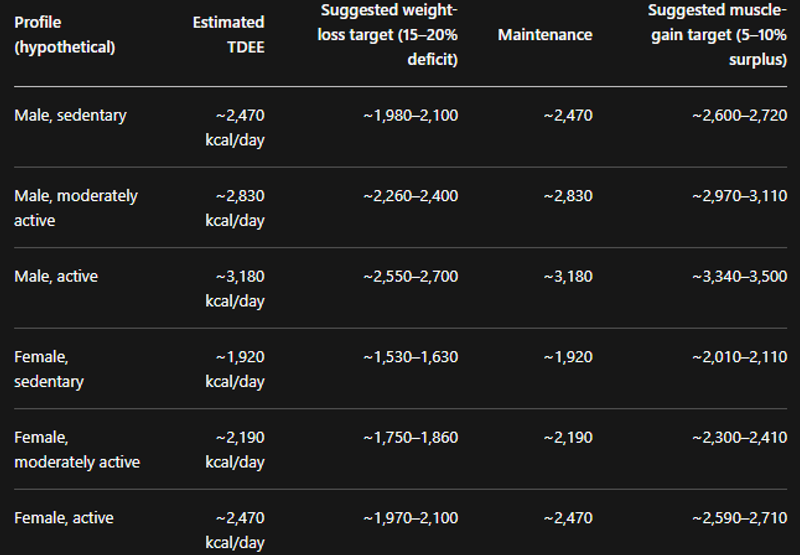
Sample table: illustrative calorie targets for six hypothetical profiles
These are not medical advice. These are example profiles with hypothetical age, height, and weight (because your demographics are unspecified), using the Mifflin–St Jeor equation and multiplying by illustrative physical activity levels (PAL). Real needs vary, and the best feedback loop is body-weight trend plus performance, hunger, and health markers.
Assumptions used for illustration only:
- Profile “Male”: 30 years, 178 cm, 80 kg
- Profile “Female”: 30 years, 165 cm, 65 kg
Tracking and accuracy: when calorie tracking helps, and when it harms
Calorie tracking is a tool. For beginners, it can teach portion reality fast. For experienced lifters, it can help keep bulks lean and cuts controlled. For clinicians, it can be a shared language for behavior change.
It can also backfire. Research on diet and fitness apps shows that some users, especially those with eating disorder vulnerabilities, can experience increased fixation and symptom exacerbation. If you have a history of disordered eating, or tracking starts escalating anxiety, rigidity, or shame, the “best” tracking plan may be not tracking, or tracking in a clinician-supervised way (qualitative logs, plate-method structure, or other approaches).
FAQs and myths
“If I eat healthy foods, calories don’t matter.”
Food quality matters a lot for health, satiety, and adherence. But bodyweight still responds to energy balance over time. Even researchers who argue strongly that food types differ biologically still treat energy balance as the core accounting principle.
“All calories are equal.”
Calories are equal as a unit of energy, but foods are not equal in how they affect hunger, TEF, digestion, and ad libitum intake. Differences in fiber, food structure, and processing can change metabolizable energy and intake behavior.
“I can out-exercise a bad diet.”
You can create a deficit via exercise, but it’s often smaller than people think, and compensation (hunger, reduced NEAT, fatigue) is common. Physical activity is still worth doing for health, strength, mood, and long-term weight maintenance, but it’s rarely a blank check.
Closing
Here’s the clean way I hold this in my head: calories are the best available accounting system for energy, not a perfect measurement of reality. If you want to lose fat, maintain weight, or gain muscle, you can use calories as the steering wheel, while still caring about food quality, protein, fiber, sleep, strength training, and mental health. The goal is not perfect tracking. It’s a plan you can actually live with, for long enough to matter.
If you want a structured way to do this, Makko can be the place you track calories and macros and turn them into consistent habits
References
- . “History of the calorie in nutrition.” Journal of Nutrition (2006).
- . “Calorie” and “Joule” glossary entries (energy unit conversion).
- U.S. Food and Drug Administration. “Calories on the Nutrition Facts Label” (content current as of March 5, 2024).
- U.S. nutrition labeling regulation (21 CFR 101.9): caloric calculation methods (Atwater, bomb calorimetry, factors) and compliance thresholds.
- “Dietary Reference Intakes for Energy” (2023): Factors affecting energy expenditure, including REE contribution, TEF, activity range, adaptive thermogenesis summaries.
- Hall KD, et al. “Quantification of the effect of energy imbalance on bodyweight.” Lancet (2011) (PMC full text).
- Hall KD. “Why is the 3500 kcal per pound weight loss rule wrong?” (2013) (PMC).
- Thomas DM, et al. “Time to correctly predict the amount of weight loss with dieting.” (2014) (PMC).
- Levine JA. “Non-exercise activity thermogenesis (NEAT).” (2002) (PubMed).
- Zou ML, et al. “Accuracy of the Atwater factors…” (2007) (PubMed).
- Novotny JA, et al. “Discrepancy between the Atwater factor predicted and empirically measured energy values of almonds…” (2012) (PubMed).
- Roberts SB, Flaherman V. “Dietary Energy.” (2022) (PMC).
- Gardner CD, et al. DIETFITS randomized trial: healthy low-fat vs healthy low-carb, 12-month outcomes. (2018) (JAMA/PMC).
- Hall KD, et al. Ultra-processed vs unprocessed diets inpatient randomized crossover trial. (2019) (PubMed/Cell Metabolism).
- American Diabetes Association. “Obesity and Weight Management for the Prevention and Treatment of Type 2 Diabetes” in Standards of Care in Diabetes (2025).
- Turnbaugh PJ, et al. “An obesity-associated gut microbiome with increased capacity for energy harvest.” Nature (2006) (PubMed).
- Verhaegen AA, et al. “Drugs That Affect Body Weight…” (NCBI Bookshelf chapter, 2019).
- Eikey EV, et al. “Effects of diet and fitness apps on eating disorder behaviours” (2021) (PMC).
Start Tracking with Makko
Put these insights into action. Track your calories, monitor your progress, and reach your goals.
Try Makko Free for 30 Days