Macro Tracking Explained
A science-backed introduction to macro tracking. Learn what protein, carbs, and fats do in the body, how to set personalized macro goals, and why this flexible, evidence-based method is a sustainable approach to dieting.
 makko
makko 
Macro Tracking Explained: Protein, Carbs, Fat, and the Science Behind Sustainable Dieting
Macro tracking is a way of eating that focuses on the three main macronutrients – protein, carbohydrates, and fat – rather than obsessing over individual foods or fad diets. In simple terms, it means keeping an eye on how many grams of each macro you eat each day. This approach has gained popularity beyond the bodybuilding crowd because it’s rooted in nutritional science and can lead to sustainable healthy eating habits for anyone. In this guide, we’ll break down what macros are, why tracking them works, and how you can use macro tracking to build a balanced, sustainable diet. We’ll keep it science-backed and approachable, so whether you’re a newbie or a seasoned pro, you’ll find value here.
What Is Macro Tracking?
Macronutrients (“macros”) are the nutrients your body needs in large amounts: protein, carbohydrates, and fat. (Vitamins and minerals, needed in smaller amounts, are “micronutrients.”) These macros provide energy (calories) and serve other vital functions in your body. Every food we eat is made up of some combination of protein, carbs, and fat. Macro tracking means you’re counting how many grams of each of these you consume daily, aiming for specific targets. Essentially, it’s a form of calorie counting that also emphasizes what those calories are made of.
One key difference from plain calorie counting is that macro tracking ensures you get a balanced mix of nutrients rather than, say, eating 1,600 calories of just donuts. Each macro contributes a certain number of calories per gram – protein and carbs have about 4 calories per gram, while fat has 9 calories per gram. This is why foods high in fat (think oils, butter, nuts) are more calorie-dense than foods high in protein or carbs. Tracking macros inherently means you’re tracking calories too, but with an added layer of nutritional awareness.
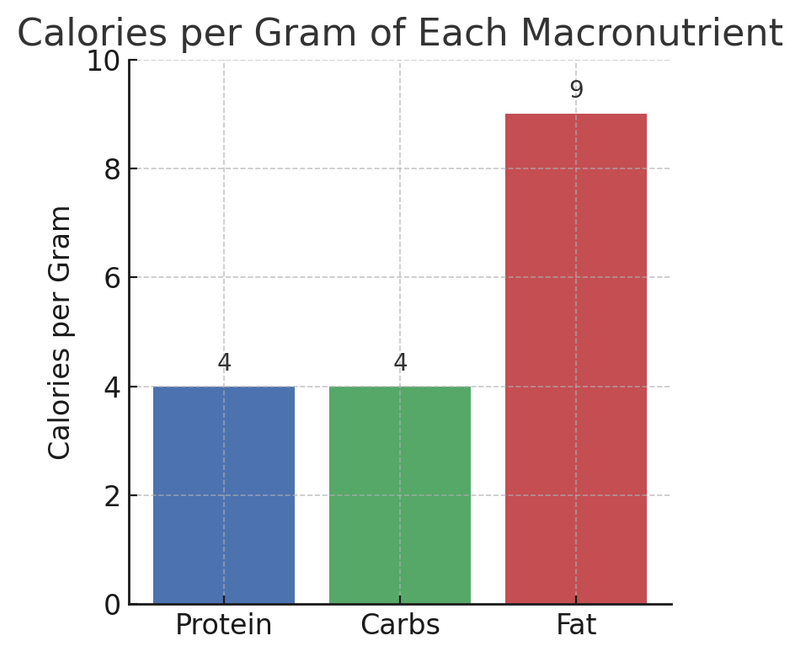
Calories per gram of each macronutrient. Fat provides more than double the calories per gram compared to protein or carbs, which is why high-fat foods are so calorie-dense.
Macro tracking was popularized by fitness enthusiasts and bodybuilders (you might have heard the phrase “If It Fits Your Macros (IIFYM)”), but it’s not just for people trying to get shredded. At its core, it’s about budgeting your calories by nutrient type. You set a daily goal for protein, carbs, and fat, and then plan your meals to hit those targets. The beauty is that no foods are off-limits – you have flexibility to eat the foods you enjoy as long as they fit into your macro goals. This flexible approach contrasts with rigid diets that ban certain foods or entire food groups (which often leads to cravings and rebound eating). By allowing a wide variety of foods, macro tracking encourages a more balanced, sustainable way of eating that you can stick with for the long haul.
Of course, macro tracking isn’t required to eat healthily – plenty of people maintain a good diet without ever logging a gram. And it’s not suited for everyone (if you have a history of disordered eating or if the idea of logging every bite stresses you out, you might take a different approach). But for many, it’s an eye-opening educational tool. It brings awareness to what you’re eating and can dispel some nutrition myths. Let’s break down each macronutrient and see why they matter.
Protein: The Building Block
Protein is often the first macro discussed in any diet plan – and for good reason. Proteins are made up of amino acids that are the building blocks of your body’s tissues. They’re used to build and repair muscle, organs, enzymes, hormones, and even your immune cells. In other words, protein is essential for keeping your body structure and machinery in top shape.
Each gram of protein provides 4 calories of energy, but unlike carbs and fat, your body prefers to use protein for growth and repair rather than as a primary fuel source. If you don’t eat enough protein, especially when dieting or exercising, your body might break down muscle tissue to get the amino acids it needs. On the flip side, a higher protein intake can aid weight management because protein is very satiating (it helps you feel full) and has a high thermic effect – your body burns 20–30% of protein’s calories just digesting it, compared to about 5–10% for carbs and 0–3% for fat. This means protein gives you more “bang for your calorie buck,” helping preserve muscle and curb hunger when you’re in a calorie deficit.
So how much protein do you need? The answer depends on your body and goals. The general minimum recommended is around 0.8 grams of protein per kilogram of body weight (about 0.36 g per pound) for a sedentary adult – that’s the RDA, mainly to prevent deficiency. But if you’re active, looking to lose fat while maintaining muscle, or aiming to build muscle, your protein needs are higher. Research suggests intakes on the order of 1.2–2.0 g per kg of body weight are beneficial when trying to lose weight or gain muscle. For example, a 70 kg (154 lb) person might target 84–140 grams of protein per day in those scenarios. In the macro tracking world, many find it convenient to set protein around 25–30% of their daily calories, though it can vary.
Protein isn’t just for bodybuilders – it’s important for men and women of all ages. In fact, women often don’t get enough protein, especially when dieting, which can lead to muscle loss or just constant hunger. Getting ample protein helps with toning, not “bulking you up” (that’s a myth – women don’t bulk up easily without extreme training and diet). And for older adults, higher protein is key to prevent age-related muscle loss. So, protein is everyone’s friend.
What does protein look like on your plate? High-protein foods include meats (chicken, beef, turkey), fish, eggs, dairy (Greek yogurt, cottage cheese), and protein-rich plant foods like beans, lentils, tofu, edamame, and chickpeas. You can absolutely hit your protein goals with plant-based foods – you might just need a bit more planning. For instance, combining legumes with whole grains can provide a full spectrum of amino acids. It’s perfectly possible to get all your protein from plant sources like legumes, nuts, seeds, and whole grains if you prefer a vegetarian or vegan diet. Here are a few examples of protein sources to work into your diet:
- Lean meats (chicken breast, turkey, lean beef or pork) – complete proteins high in essential amino acids.
- Fish and seafood (salmon, tuna, shrimp) – also provides healthy fats (omega-3s) in many cases.
- Eggs and dairy (eggs, Greek yogurt, low-fat cottage cheese, milk) – convenient and high-quality protein.
- Plant proteins (beans, lentils, chickpeas, tofu/tempeh, edamame, quinoa) – offer protein plus fiber and micronutrients; combine different plant sources to cover all amino acids.
- Protein supplements (whey or plant-based protein powder) – not necessary, but can help if you struggle to eat enough protein from food alone.
If you start tracking protein, you might be surprised at how quickly it adds up with the right foods – or conversely, how easy it is to undereat protein if your diet is mostly carbs and fat. Hitting your protein target consistently is often the biggest game-changer for people new to macro tracking, impacting satiety and muscle retention significantly.
Carbohydrates: The Primary Fuel
Carbohydrates (“carbs”) are your body’s main energy source. They often get a bad rap in fad diet circles, but carbs are not the enemy – they’re a broad category that includes everything from oatmeal and apples to cookies and soda. Chemically, carbs are sugar molecules, and they come in various forms. Simple carbs are smaller molecules (like glucose, fructose, sucrose) that digest quickly – think table sugar or the natural sugar in fruit. Complex carbohydrates are longer chains of sugars (like starch and fiber) that take longer to break down, providing more steady energy. Typically, complex carb sources like whole grains, beans, and vegetables are more nutrient-dense and keep you fuller longer than refined simple carbs.
Carbs also provide 4 calories per gram. When you eat carbs, your body breaks them down into glucose, which is used by your cells for immediate energy. Any extra glucose can be stored in your muscles and liver as glycogen (your short-term energy reserve), and beyond that, converted to fat for long-term storage. Carbs are particularly important if you are active – your muscles run on carbohydrate when you’re doing moderate to high intensity exercise. Your brain, too, prefers glucose as its fuel. This is why very low-carb diets can cause some people to feel sluggish or foggy at first.
However, not all carbs are created equal in terms of nutritional value. A diet high in refined carbs (like white bread, pastries, sugary drinks) can cause spikes and crashes in blood sugar and often leaves you less satisfied, leading to hunger sooner. On the other hand, fiber-rich carbs (vegetables, fruits, whole grains, legumes) digest slower and help stabilize blood sugar. Fiber is actually a form of complex carb that we can’t fully digest, and it has huge benefits: it fills you up, aids digestion, and even feeds healthy gut bacteria. For example, an apple and a spoon of sugar are both “carbs” but the apple’s fiber will slow its sugar release and contribute to satiety, while the spoon of sugar hits your bloodstream fast and leaves you wanting more. As Harvard’s nutrition experts succinctly put it, the type of carbohydrate in your diet is more important than the total amount – meaning focus on quality carbs.
So how many carbs should you eat? The answer can vary widely. Generally, health guidelines suggest anywhere from 45% to 65% of your calories coming from carbohydrates for adults. If you’re very active or an endurance athlete, you might be toward the higher end (or even higher for intense training). If you prefer a lower-carb approach or have certain conditions like insulin resistance, you might aim for the lower end of that range. There are even ketogenic diets that go extremely low (under 10% of calories from carbs) to force the body to use fat for fuel – but those are specialized approaches, and certainly not the only path to health or weight loss. In fact, large studies have found that people can lose weight on high-carb or low-carb diets alike as long as calories are controlled; what matters most is finding a balance you can stick to.
For sustainable dieting, outright carb elimination isn’t necessary (unless you have a medical reason). Instead, a sustainable macro approach would have you include a variety of carbs that you enjoy and that nourish you. This could mean oatmeal or whole-grain toast at breakfast, a sandwich or salad with beans at lunch, some fruit for snacks, and a side of brown rice or sweet potato with dinner. Even some “treat” carbs can fit – like a bit of chocolate or a cookie – if you account for them. By tracking, you’ll naturally become aware of the carb content in foods and can make informed choices (for example, you might decide that a huge glass of sweet tea that uses up 50g of your carbs isn’t “worth it” and opt for water and save those carbs for something more filling).
Some carb sources to emphasize in a balanced macro diet include:
- Whole grains – e.g. brown rice, quinoa, oats, whole wheat bread or pasta. These provide energy, fiber, B-vitamins, and more.
- Fruits – nature’s convenience snack, packed with vitamins, fiber, and antioxidants (yes, they contain sugar, but in a package that’s good for you).
- Vegetables – leafy greens, broccoli, carrots, potatoes, etc. Mostly carbs, very nutrient-dense per calorie, and high in fiber. Aim to fill half your plate with veggies when you can.
- Legumes (beans, lentils, peas) – these are both high in carbs and protein, plus fiber, making them a fantastic staple, especially for plant-based diets.
- Dairy or dairy alternatives – milk, yogurt, etc., contribute carbs (lactose) along with protein and calcium.
Carbs to be mindful of would be the sugary and highly-refined stuff: e.g. candy, sugary cereals, white bread, soda. You don’t have to ban them (a sustainable diet can include a cookie or a soda here and there if it “fits your macros”), but you learn to moderate them. Many people following macro tracking use an 80/20 rule – about 80% of carbs (and other foods) from wholesome sources, 20% from “fun” treats. This way, you get the nutrients and fiber you need, but also the flexibility to enjoy life.
Fat: Essential for Health
Dietary fat has worn the black hat in past decades of diet trends, but it’s finally getting its due respect as a vital nutrient. Fat is absolutely essential for your health. It’s a major component of cell membranes, it’s required for your body to produce important hormones (like testosterone and estrogen), and it’s needed to absorb fat-soluble vitamins A, D, E, and K. Certain fats, like omega-3 fatty acids, have well-known benefits for heart and brain health. In short, we need fat in our diets.
Fat is also the most calorie-dense macro: it provides 9 calories per gram (more than double the calories of the same weight of protein or carbs). This means high-fat foods are easier to overeat if you’re not paying attention – a handful of nuts or a couple tablespoons of peanut butter (healthy as they are) pack a lot of calories. This is one reason people used to fear fat when weight loss was the goal. But cutting fat too low can backfire. Extremely low-fat diets can interfere with hormone levels, leave you feeling unsatisfied (since fats contribute to the flavor and texture of foods), and make it hard to get enough essential fatty acids and fat-soluble vitamins.
Instead of fearing fat, the key is to focus on healthy sources of fat and consume them in appropriate amounts. Generally, 20% to 35% of your daily calories should come from fat for a balanced diet. For someone eating 2,000 calories, that’s about 44 to 78 grams of fat per day. Going below 20% isn’t typically recommended long-term because it can shortchange you on essential nutrients (and might make your diet hard to stick to).
Not all fats are equal: we have saturated, unsaturated, and trans fats. Saturated fats are found mostly in animal products (meat, butter, cheese) and some tropical oils; they’re okay in moderation, but a high intake is linked to higher LDL cholesterol and heart disease risk, so experts suggest capping saturated fat at <10% of your calories. Trans fats, which are artificially hydrogenated oils found in some processed snacks and margarine, are best avoided entirely – they’re clearly harmful to heart health. Unsaturated fats (both monounsaturated and polyunsaturated) are the stars: these come from plant-based oils, nuts, seeds, avocado, and fatty fish. They can improve cholesterol profiles and have anti-inflammatory benefits. For example, omega-3 fats (like those in salmon, flaxseed, or walnuts) support heart and brain health, and omega-6 fats (in many nuts and seeds) are also essential in the right balance.
Practically speaking, hitting your fat macros might involve adding a thumb of olive oil while cooking, a sprinkle of nuts or seeds on a salad, or enjoying a portion of avocado or peanut butter. If you’re tracking, you’ll become aware that things like cheese, fatty cuts of meat, butter, and oils carry a lot of fat. You don’t need to cut them out; just measure reasonable portions. A little can go a long way.
Great sources of healthy fats to include in your diet:
- Oils: Olive oil, avocado oil, canola oil for cooking or dressings – rich in unsaturated fats. (Limit butter and avoid shortening or margarine with trans fat.)
- Nuts and seeds: Almonds, walnuts, chia seeds, flax seeds, peanuts, etc. These provide healthy fats plus protein and fiber.
- Avocado: A fantastic source of monounsaturated fat (and delicious on almost anything!).
- Fatty fish: Salmon, mackerel, sardines – provide omega-3 fats and protein.
- Dairy (in moderation): Foods like cheese or whole milk yogurt have saturated fat but also deliver protein and calcium. They can fit in your macros; just be mindful of portions.
Including a dose of fat in your meals is actually helpful for satiety and taste. For instance, adding a bit of olive oil or half an avocado to a salad can make it much more satisfying (and help you absorb the vitamins in those veggies). Many people find that when they incorporate moderate amounts of healthy fats, they feel more satisfied and don’t need to snack as much.
One thing to remember with fats when macro tracking: because they are calorie-dense, portion sizes matter. If your target is, say, 60 grams of fat per day, that could be blown quickly by heavy-handed pouring of oil or large servings of nuts. Tracking will teach you what those portion sizes look like. But again, the goal is not to eliminate fat – it’s to ensure you get enough of the good ones while staying within your calorie needs.
Why Macro Tracking Works (The Science Behind It)
By now you might be thinking, “Alright, I know what protein, carbs, and fat do. But why go through the effort of tracking them? Can’t I just eat ‘healthy’ and call it a day?” You absolutely can eat a healthy diet without tracking, but there are some compelling reasons why the macro tracking approach has helped many people succeed in reaching their fitness or weight loss goals where previous diets failed. Let’s dig into the science and practical benefits:
- It aligns your diet with the fundamental laws of energy balance. At the end of the day, whether you lose, gain, or maintain weight comes down to calories in vs. calories out. No matter what a diet is called – keto, low-fat, high-protein, paleo – if you’re losing weight on it, you’re eating fewer calories than you burn. Macro tracking is not a magic trick that sidesteps calories; in fact, it explicitly makes you aware of your calorie intake (since macros add up to calories). Research has shown that many different macro ratios can lead to weight loss, as long as you sustain a caloric deficit. The most important factor is adherence: can you stick to the nutrition plan consistently? This is where macro tracking shines – it helps you find a personalized mix of foods (and macros) that you can stick with, rather than forcing a one-size-fits-all rule.
- It helps you individualize and optimize your nutrition. While any calorie deficit can cause weight loss, the composition of those calories can affect your body composition and how you feel. For example, say two people both eat 1,800 calories a day: one person gets 100g of protein, the other only 50g. Even if both lose weight, the higher-protein dieter will likely retain more muscle mass and feel less hungry. The macro-balanced diet can also provide more steady energy (with complex carbs) and better nutrient distribution. Studies comparing diets often find minimal differences in weight loss between different macro ratios when calories are equal – a famous study had low-carb and low-fat groups end up with almost identical average weight loss – but differences can emerge in things like satiety, cholesterol levels, or muscle preservation. The best diet is one you can stick to, and one you can stick to is usually one that keeps you nourished and satisfied. Macro tracking gives you the feedback to tweak your protein, carb, and fat intake to find that sweet spot for you.
- Macros influence fullness and adherence. One reason a balanced macro approach is more sustainable than, say, a crash diet of just grapefruit, is that it naturally addresses hunger and cravings. High-protein diets are well known to reduce appetite and curb cravings because protein affects hunger hormones and is slow to digest. Fiber-rich carbs (vegetables, whole grains) add bulk to meals, making you physically full, and stabilize blood sugar so you don’t get “hangry” an hour after eating. Including some healthy fats can slow digestion and provide a feeling of satiety (plus make your food taste better). By ensuring you get enough of each macro, you’re less likely to feel deprived. Compare this to extreme approaches – if you cut carbs to the bone, you might lose water weight fast but many people find their energy tanks and they crave bread like crazy; if you cut fat too low, meals might feel unsatisfying and you could develop fat-soluble vitamin deficiencies; if you skimp on protein, you might find yourself losing muscle and constantly snacking. Balance leads to better adherence, and adherence leads to results.
- Flexible, not rigid – psychology matters. Traditional “dieting” often comes with a rigid mindset: certain foods are “bad” or off-limits, and if you eat them, you’ve “failed.” Macro tracking flips that script. Since any food can technically fit into your macros, there are no outright “forbidden” foods. This is a hallmark of what psychologists call a flexible dieting approach, which is associated with better long-term success than rigid dieting. When you know you can have a cookie or some pizza as part of your plan (maybe you budget for it by eating a lighter lunch with more protein and veggies), you’re less likely to binge or feel guilty. Many people find this eliminates the all-or-nothing thinking. You don’t “blow your diet” with one treat – you log it, enjoy it, and move on. Over time, this can foster a much healthier relationship with food. In fact, a study on flexible vs. rigid dieting in athletes showed that both approaches yielded similar weight loss, but the flexible dieters felt less restricted and were able to maintain their results better post-diet. The takeaway: sustainability. A plan you can stick to for months and years will beat a “perfect” plan you abandon after 3 weeks.
- Nutritional awareness and education. Another big reason macro tracking “works” is that it’s a learning tool. When you track your meals, you start to see patterns: Wow, that muffin at breakfast had 50g of carbs and almost no protein – no wonder I was hungry by 10am. Or I only got 10g of fiber today; maybe that’s why things aren’t… moving along. By bringing attention not just to calories but to the breakdown of those calories, macro tracking makes you more aware of your food choices. Over time, you naturally gravitate to choices that make you feel good and meet your goals (because hitting your protein target feels better than blowing your daily fat budget on a giant dessert). You’ll also become a pro at reading nutrition labels and estimating portions, which is a life skill in itself. Even if you don’t plan to track forever, the knowledge you gain can stick with you. Many people use tracking for a few months to “calibrate” their understanding of portions and macros in foods, and later transition to a more intuitive style of eating using that knowledge.
- Preserving muscle and metabolic health. When dieting for fat loss, one concern is losing muscle or slowing your metabolism drastically. Adequate protein intake, ensured through macro tracking, helps protect your lean muscle as you lose weight. And by not driving your calories too low (since you’re monitoring intake), you avoid the pitfall of crash diets that can cause extreme metabolic adaptation. In fact, macro tracking can ensure you’re not under-eating unintentionally, which is important for athletes or very active people who need sufficient fuel to perform and recover. Some folks (especially women) find that when they first calculate their macro needs, they had been eating too little, not too much, which left them in chronic low-energy mode. Hitting the right macros can actually mean eating more of the good stuff and feeling better.
In summary, macro tracking works because it marries the science of nutrition (meeting your body’s needs for protein, carbs, fats, and overall calories) with the psychology of eating (flexibility, personal preference, and awareness). It’s not a “diet” you go on and off; it’s a framework to structure your eating in a way that can be sustained. By focusing on macros, you naturally tend to improve diet quality (with a caveat: you could technically hit your macros eating junk food, but most people find that’s hard to do while staying within calorie limits, and they start choosing more nutrient-dense foods). In fact, one must remember food quality still matters – hitting your macro numbers with only processed foods vs. mostly whole foods will feel very different. Macro tracking doesn’t automatically ensure you get enough vitamins or fiber, so you do want to include plenty of fruits, veggies, and whole foods (generally, if ~80% of your foods are high-quality, your micros take care of themselves). Think of macros as the big picture, and within that, aim for a variety of nutritious foods. As one source notes, two meals could have identical macros but totally different micronutrient profiles – e.g. a fast-food burger vs. a balanced meal of grilled fish, quinoa, and veggies might both be 500 calories with equal macros, but the latter obviously brings more vitamins and fiber to the table. So, use macros as a guide, not a sole measure of a food’s value.
How to Start Tracking Your Macros
Getting started with macro tracking might sound complicated, but it’s quite straightforward once you get the hang of it. Here’s a step-by-step guide:
1. Determine your calorie needs and goals. First, figure out approximately how many calories you need per day. This depends on your basal metabolic rate (BMR) and activity level. There are online calculators and even government tools like the NIH Body Weight Planner that can estimate this for you. For a rough start, you can also use formulas (like Mifflin-St Jeor) or simpler: multiply your body weight in pounds by 14–16 for a maintenance estimate if you’re moderately active (closer to 14 for sedentary, 16 for very active). It’s just a starting point. If your goal is weight loss, you’ll aim for a calorie intake a bit below maintenance (a deficit of 300–500 calories per day is a common, sustainable range). For weight gain (muscle building), you’d aim for a surplus (e.g. +200–300 calories/day). If your goal is to maintain weight but improve nutrient balance or body composition, you might stick around maintenance calories.
2. Set your macro targets. With your calorie target in mind, decide on a macro breakdown (% of calories from protein, carbs, and fat). There’s no one “perfect” ratio for everyone, but a balanced starting point is often Protein ~25-30%, Fat ~25-30%, Carbs ~40-50% of calories. This falls within standard healthy ranges. You can adjust based on personal preference: love bread and fruit? You might go 50-55% carbs and slightly lower fat. Really enjoy nuts, avocado, and oily fish? You might be toward 30-35% fat and a bit lower on carbs. If you’re focused on muscle gain or retention, you might push protein toward the higher end (30-35%). Remember that men and women generally use similar macro ratios – the difference is mostly in total calories. (Men often need more calories overall due to having more muscle mass, but both men and women thrive on balanced macros.)
For example, let’s say you’ve worked out that you need 2,000 calories a day to lose weight at a healthy pace. You decide on a 50% carbs, 25% protein, 25% fat distribution – a fairly typical moderate setup. In calories, that means: 50% of 2000 = 1000 calories from carbs, 25% = 500 from protein, 25% = 500 from fat. Now convert those to grams using the calorie-per-gram values we mentioned:
- Carbs: 1000 calories ÷ 4 = 250 grams of carbs per day
- Protein: 500 calories ÷ 4 = 125 grams of protein per day
- Fat: 500 calories ÷ 9 = 55.6 grams of fat per day (you could round that to ~55 g)
This would be your daily macro budget. (Notice how fat grams are lower relative to calories – that’s the 9 cal/gram effect in action.)
Example of a daily macro ratio. In this scenario, 50% of calories come from carbohydrates, 25% from protein, and 25% from fat – a common balance for general fitness or weight loss. Your own macro ratio can be adjusted based on your goals and what makes you feel best.
If you’re not into percentages, another way to set macros is by targeting specific gram amounts: for instance, some people aim for about 1 gram of protein per pound of body weight (which is roughly 2.2 g/kg – on the higher end but easy to remember), then set fat around 0.4–0.5 grams per pound, and fill the rest of calories with carbs. Any method that lands you in a sensible range is fine – don’t let the math intimidate you. It’s also worth noting your macro targets aren’t set in stone; you can adjust them if you find you’re too hungry, low on energy, or not getting results. It’s your customized plan.
3. Choose a tracking tool and start logging. The easiest way to track macros is by using a smartphone app or website. MyFitnessPal, Makko, Cronometer, LoseIt, My Macros+, and others are popular options. These apps have large food databases: you search or scan a food, input the amount you ate (weighing your food with a kitchen scale or measuring cups increases accuracy), and it adds up your protein, carbs, fat, and calories for you. You can also save meals or recipes you eat often. In the beginning, it’s very useful to weigh and measure portions to learn what, say, 100 grams of chicken or 1 tablespoon of peanut butter actually looks like. With practice, you get a feel and might not need to measure as strictly. But those initial efforts teach you portion sizes and prevent “calorie creep” (it’s super easy to underestimate portions if you never check).
When logging, try to be consistent. Log as you go or set aside time at the end of the day. Many find it helpful to plan meals ahead of time – even the day before – by plugging in what you intend to eat to see how the numbers shake out, and then you can adjust portion sizes or food choices proactively. For instance, you might log your breakfast, lunch, and dinner in the morning, realize you’re a bit low on protein, and decide to add a Greek yogurt snack in the afternoon to hit your target. Or you might see you only have 10g of fat left for the day and opt for a lower-fat dinner to stay on track. It’s like solving a puzzle that adjusts throughout the day.
Some quick pointers for logging:
- Be honest and accurate. It’s data for you – no one else sees it – so log that butter on your toast or the mayo in your sandwich. Those add up and are part of your macros. If you don’t log everything, the numbers won’t make sense.
- Mind liquid calories. Drinks like soda, juice, alcohol, or creamer in coffee have macros too. For example, one cup of orange juice has ~26g carbs (roughly like a serving of fruit) and a glass of wine has ~4g carbs and ~0g fat/protein but ~120 calories from the alcohol itself. Alcohol isn’t a macro we count in the big three (it’s actually ~7 calories per gram and not nutritionally necessary), but if you drink, account for those calories in your plan. Most tracking apps will log alcohol and include its calories.
- Use consistent entries. Food databases can be crowdsourced, so sometimes you’ll find multiple entries for “grilled chicken breast” with slightly different counts. Look for verified or common entries (or create your own) to use consistently. Over time, you’ll have your go-to foods in the app which makes logging faster.
- Don’t stress perfection. Hitting your macros exactly is not necessary (nor realistic). Aim within a reasonable range – some use a ±5g or ±10% rule. If you go a bit over on one macro and under on another, it’s okay. The goal is to be in the ballpark and create awareness. Your body won’t freak out if you ate 10 grams less carbs one day. The consistency over weeks is what counts.
4. Monitor progress and adjust as needed. Give yourself a couple of weeks on your chosen macro plan and see how you feel and how your body responds. Are you losing, gaining, or maintaining as expected? How’s your energy in workouts? Your hunger levels? If you’re not seeing the desired trend in weight or measurements after 2-3 weeks, you might need to tweak total calories (down a bit if trying to lose, up if trying to gain). If energy is low or you’re excessively hungry, consider shifting your macro balance – e.g. some people feel better upping fats slightly for better satiety, others might need a bit more carbs to fuel workouts. The macro template is adjustable. For example, a long-distance runner might increase carbs significantly, whereas someone with insulin resistance might feel better on slightly lower carbs and higher fat/protein. Listen to your body and don’t be afraid to experiment within the realm of healthy, whole foods.
It’s also wise to take notes on other aspects of health: sleep, mood, workout performance, etc., as you adjust your diet. Macro tracking gives you concrete numbers to correlate with these variables. Maybe you notice that when you get at least 30g of fiber (from those healthy carb sources) you feel great and digestion is smooth – that’s a win to continue. Or you notice every time you eat a lot of a certain food, you feel bloated – that’s useful info too (though that’s more about what you ate than the macro count).
5. Keep it sustainable. The whole point of this being a sustainable diet strategy is that you should still enjoy your food and your life. Build in some of your favorite foods, exercise flexibility for special occasions, and don’t become overly fixated on the numbers. They’re there to serve you, not the other way around. If you hit, say, 140g protein when your goal was 150g, but you’re full and satisfied – it’s okay. If you go to a birthday dinner and don’t track that meal, it’s not the end of the world; one meal won’t derail progress. Some people use an approach where they are strict with macros during the week and a bit more relaxed on one weekend day (still mindful, but not weighing lettuce at a restaurant). This can be mentally refreshing and hardly impacts long-term results as long as it doesn’t turn into a binge-fest.
Also, periodically, you might recalculate your macros as your body or goals change. If you’ve lost a lot of weight, your calorie needs may be lower now, so those initial macro targets might need updating. If you’ve gained muscle or started training for a marathon, you likely need more calories and carbs. Think of macro tracking as a dynamic tool that evolves with you.
A Note on Different Diet Preferences
One great thing about macro tracking is that it’s diet-agnostic. It doesn’t impose a specific eating style; it works with nearly any preference or requirement:
- If you’re vegetarian or vegan, you can absolutely track macros – your protein will just come from plant sources (tofu, beans, lentils, seitan, etc.) and you might allocate a bit more effort to hitting protein goals, but plenty of plant-based athletes do it.
- If you follow keto or low-carb, well, you’re essentially doing macro tracking with a specific ratio (e.g. 5% carbs, 70% fat, 25% protein or similar). Macro tracking can help ensure you’re staying in that carb limit and getting enough protein without too much.
- If you prefer Mediterranean or paleo diets, you can use macro targets within those food choices easily.
- If you have food allergies or intolerances, tracking can actually help ensure you’re not missing anything (for example, if you’re lactose intolerant and avoid dairy, tracking might show you that your calcium or maybe your protein is lower, and you can then include alternatives).
- For men vs. women, as mentioned, the approach is fundamentally the same. Both benefit from adequate protein, healthy fats, and quality carbs. Women might have slightly different micronutrient needs (like iron, calcium – e.g. women need more iron due to menstrual losses), but macros themselves are universal. Women should not shy away from protein or carbs – those macros are crucial for them too. Men typically just have a higher calorie budget, meaning more grams of each macro, but percentage-wise similar ranges apply.
The inclusive nature of macro tracking means it can be tailored to you. It’s not a rigid prescription that you must eat chicken, broccoli, and rice every meal (though if you like that, more power to you!). You can be a foodie who loves cooking elaborate meals, or someone who prefers the same breakfast and lunch every day – as long as the macros line up over the day, either style works. Some like to incorporate intermittent fasting (restricting eating to certain hours) – you can do that with macros too; you’d just eat your day’s macros in a smaller time window. The flexibility is endless.
Potential Downsides and Misconceptions
To be balanced, it’s worth briefly acknowledging potential downsides of macro tracking – not to dissuade you, but to help you approach it healthily:
- Learning curve and effort: In the beginning, tracking does take effort. You have to log foods, which can feel tedious. There’s also a bit of a learning curve using apps and a food scale. Some people love the structure; others feel constrained by it. The good news is it gets much easier with time (logging can take just 5 minutes a day once you have routine meals) and you can automate a lot. But be prepared for the initial commitment.
- Risk of obsessive behavior: Because tracking involves numbers, it can tip into obsession for certain personality types. If you find yourself getting anxiety over eating an untracked meal or you’re sacrificing social life to perfectly hit macros, step back. Remember, macros are a tool to enhance life and health, not dominate it. It’s okay to estimate or take a break if needed. Some days you might eat out and not know exact counts – you can either guesstimate or just enjoy and get back on track next meal. Perfection is not required for progress.
- Not a guarantee of a balanced diet: Hitting macro targets doesn’t automatically mean you’re getting enough micronutrients. It’s possible to fill your fat quota with butter and your carb quota with sugar – and technically those are “on target” but that wouldn’t be a nutritious diet. So use common sense: emphasize whole foods, fruits, veggies, lean proteins, etc., within your macros. Many tracking apps also show fiber, vitamins, and minerals – pay attention to those too. If you notice you’re low on fiber or certain vitamins regularly, incorporate foods to address that. For instance, if fiber is low, add more veggies or swap white bread for whole grain. If iron is low, include some spinach or lean red meat, etc. Macro tracking is a big piece, but overall diet quality still matters.
Now that we’ve covered the groundwork, you should have a solid understanding of macro tracking and why it’s a popular, science-backed approach. Let’s summarize the key takeaways.
The Bottom Line
Macro tracking is a powerful tool for taking control of your nutrition. By focusing on protein, carbs, and fat, you ensure that your body gets what it needs to function optimally: protein to rebuild and protect lean muscle, carbs to fuel your body and brain, and fats to support hormones and absorb nutrients. Unlike restrictive diets that cut out entire food groups or have you eating cabbage soup for a week, macro tracking promotes balance and flexibility. It’s grounded in the reality that calories matter, but also in the understanding that where those calories come from matters for how you feel and perform.
This approach works for a wide range of people – from someone just starting their fitness journey who needs an easy framework, to a seasoned athlete dialing in their intake for performance. It’s introductory enough that a newbie can start with basic macro targets and learn as they go, but nuanced enough that a pro can fine-tune their macro split and nutrient timing for that extra edge. Most importantly, it’s meant to be sustainable. By allowing all foods (in moderation) and encouraging you to find a macro balance that suits your unique lifestyle, it steers you away from the yo-yo diet cycle.
Keep in mind, macro tracking is not the only way to eat healthily. Some people thrive with alternative approaches like mindful eating, portion control guides (e.g. using your hand as a serving guide), or other methods – those can be topics for another day. The best approach is one that you can maintain and that supports both your physical and mental well-being. Macro tracking just happens to be a method that ticks those boxes for many, by combining structure with flexibility.
If you decide to give macro tracking a try, embrace it as a learning experience. The first few weeks are the most educational. You’ll likely have a few “aha!” moments – perhaps realizing you weren’t eating as much protein as you thought, or that your favorite “healthy” smoothie had more sugar than a candy bar. Use that insight to adjust and find better alternatives that you enjoy just as much. Over time, you’ll build a repertoire of go-to meals that hit your macros nicely. You’ll also get more intuitive – you’ll know roughly how much chicken or rice fits your plan without always needing a scale. That’s the endgame: building lasting habits and knowledge so that whether or not you track every day, you have the skills to compose a balanced diet.
In conclusion, macro tracking is about empowerment through knowledge. It strips away the hype and gimmicks of dieting and focuses on what truly matters nutritionally. By understanding the role of protein, carbs, and fat – and tailoring them to your needs – you’re setting yourself up for a sustainable way of eating that fuels your goals and keeps you healthy. So if you’ve been curious about macro tracking, consider this your invitation to dive in. Grab a tracking app, set your targets, and see how it goes. Give it a few weeks, and don’t let perfectionism stop you. You might be surprised at not only the results you see, but also how much you learn about your body and food along the way.
Happy tracking, and here’s to building a diet that truly works for you!
References: (Scientific sources and articles that informed this guide)
- U.S. Dietary Guidelines for Americans, 2020-2025 – recommended macronutrient distribution ranges.
- Healthline – Best Macronutrient Ratio for Weight Loss (importance of calorie deficit and various macro ratios).
- NCBI – StatPearls: Nutrition: Macronutrient Intake, Imbalances, and Interventions (roles of protein, carbs, and fats in the body).
- Precision Nutrition – Should You Track Your Macros? (benefits of tracking, awareness, ensuring enough intake, flexible vs rigid control).
- GoodRx Health – What Are Macros and Should I Be Counting Them? (intro to macros, examples of healthy sources, and caution for disordered eating).
- Obesity Action Coalition – Differences in Gender-Based Dietary Needs (men vs women calorie needs and identical macro percentage recommendations).
- Plus various nutritional studies on diet adherence and flexible dieting (e.g., flexible vs rigid dieting study) that reinforce the importance of personalizing your approach for sustainability
Start Tracking with Makko
Put these insights into action. Track your calories, monitor your progress, and reach your goals.
Try Makko Free for 30 Days